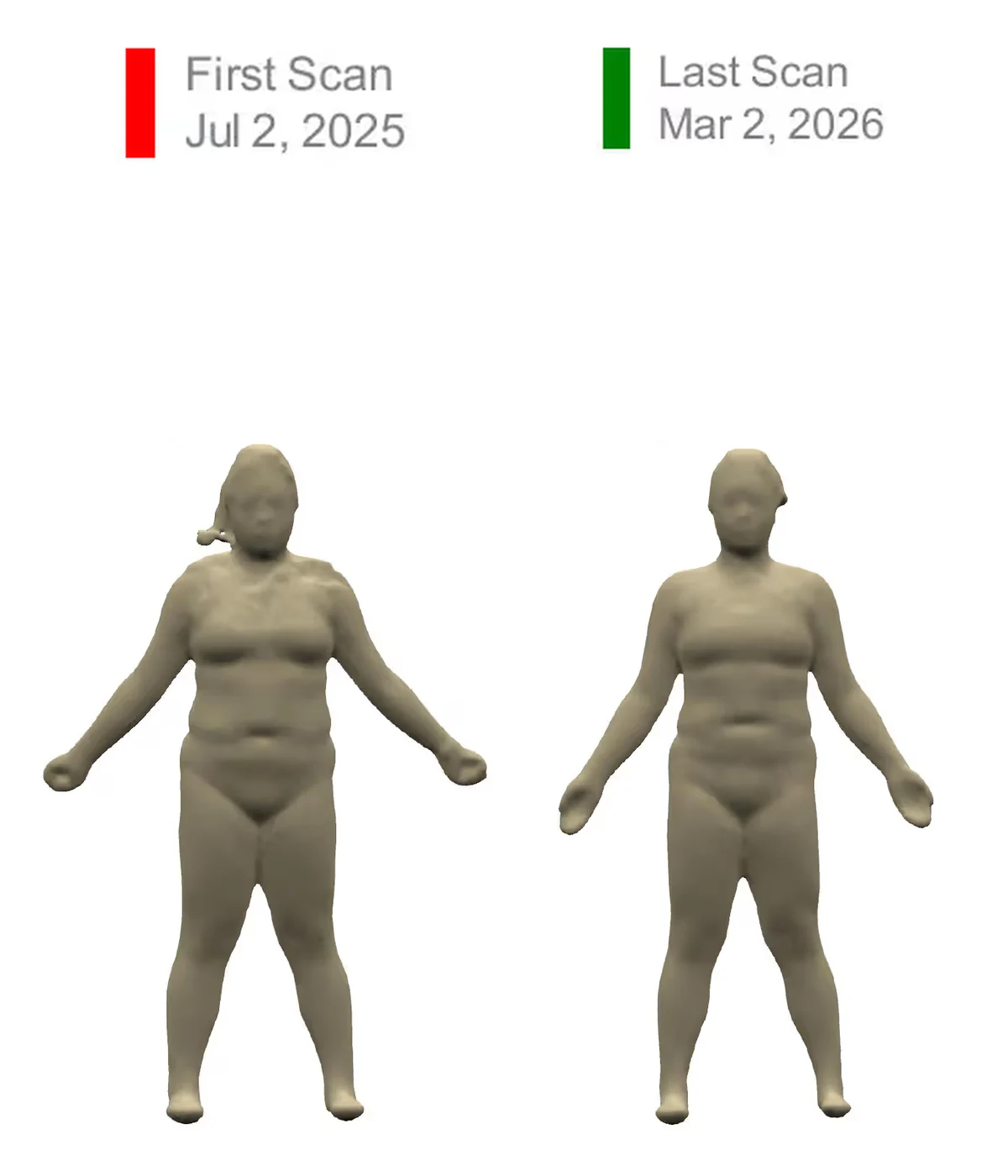
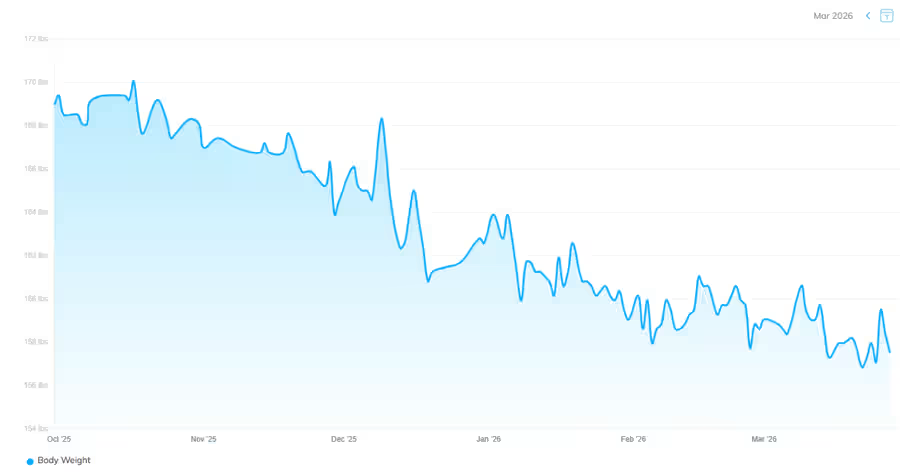
178 → 157 lbs (−21 lbs) · Torso down 14.1 inches · 8 months
Her coach Joe put it bluntly: "It's pretty good, but it's not good enough." That was Mary Ng's problem in a sentence — an occupational therapist and avid hiker who was already active, already eating reasonably well, and still stuck at the same weight for months. Over about 8 months at Kraken Fitness in Burnaby, once Joe swapped her macro tracking for a simple food list, she lost 21 pounds, blew past her original 20-pound goal, and hiked Panorama Ridge without being the one holding her friends back for the first time ever.
Mary was already active — hiking, tennis, snowboarding all winter. Never a couch person, but never a "gym person" either. She just couldn't lose the weight.
Macro tracking was the first plan Joe tried. It asked for more precision than Mary could sustain on top of a full-time job, and compliance sat around 40%. The scale didn't move.
So Joe scrapped the macros and gave her a structured food list instead — pre-set meals, weighed portions, no math required. Compliance jumped to 85%+ almost immediately, and the plateau she'd been stuck at for months broke within two weeks.
Eight months in: 21 lbs down, past her original goal, still training with Joe, now chasing another 10. And she finished the Panorama Ridge hike without her friends waiting on her — the first time that's ever happened.
She wasn't broken. She just needed the last 30%.
Here's what 8 months of training produced:
From Styku 3D body scan data (Jul 2025–Mar 2026): her total torso circumference dropped 14.1 inches, with her waist alone coming in 2.5 inches smaller — the kind of change that shows up in how clothes fit before it shows up on a scale. Visceral fat, the fat surrounding her internal organs and tied to metabolic health risk, dropped nearly 15%. Her bicep circumference grew 0.7 inches — real muscle gained alongside the fat loss, not just weight coming off.
Joe's read on her: "It's kind of tricky where it's like, it's pretty good, but it's not good enough." That line is the whole story. She wasn't broken. She just needed the last 30%.
Mary is an occupational therapist working in mental health disability services, early 30s. Grew up between Hong Kong and the UK, did her OT training back in Hong Kong, then moved to Vancouver for her program. She'd had a personal trainer years ago in Hong Kong but let it lapse through school — no time, no budget. Once her career and life settled into a rhythm, both came back.
She was never a couch person. Hiking, tennis, snowboarding in season — she stayed active on her own terms. But she wasn't a "gym person," and a long stretch without structured training had crept up on her.
Two things brought her in. She wanted to lose 20 pounds. And she had Panorama Ridge on the calendar — a serious group hike — and didn't want to be the reason everyone stopped to wait. That second goal mattered more than the number on the scale. She'd been the slow one on group hikes before, and she was done with it.
She signed up for 2x/week personal training with Joe at the North Burnaby studio, no illusions about it being easy, just ready to put in the work she already knew how to do outdoors and apply it somewhere structured.
Her numbers told an unusual story for a new client: 178 lbs, 35.9% body fat, and an FMS score of 15 out of 21 — solid, clean movement patterns from day one. Joe noticed it immediately on her first squat: "That's like a pretty perfect squat right there." Most people who walk in cold don't move like that.
Steps were already good, especially in summer. Sleep was generally fine, aside from the occasional roommate disruption. Stress was moderate — she worked overtime but had her life reasonably together. And nutrition knowledge wasn't the gap either. She already knew the difference between a good meal and a bad one.
So what was actually limiting her? Not movement. Not education. Not motivation. It was consistency — specifically, weekend consistency. Her weekdays were solid. Then the weekend would hit and the calories would climb: eating out, snacking, portions creeping up without her tracking any of it.
Joe's assessment was blunt but accurate: she didn't have glaring problems. She had a 30% gap between doing pretty well and doing well enough to actually change her body. That gap is harder to coach than a client who's starting from zero, because there's no obvious fix to point at. It meant the plan had to be precise, not dramatic.
Joe started her on macro tracking right away, since she'd never done it before and it's the standard entry point for a client who already understands food quality. The early weeks were rough — cups instead of a scale, rounded-up guesses, logging that happened some days and not others. Compliance sat around 40%.
It wasn't a lack of effort. Macro tracking asks a lot of a beginner all at once: weighing food, hitting three separate targets, logging consistently, doing math on restaurant meals. For someone who'd never tracked before, that's a steep learning curve to climb while also working full-time and living an active life outside the gym.
Joe watched the compliance numbers rather than making excuses for them. Forty percent wasn't going to move the scale in any meaningful way, no matter how good her workouts were. Something about the system itself needed to change — not her effort, the tool she was using.
That's the piece that gets missed with plateaued clients. The instinct is to push harder on the same plan. Joe went the other direction: strip the plan down until it actually fit how Mary lived.
Macro tracking failed because it demanded more precision than Mary could sustain on top of a full-time job and an active outdoor life. Forty percent compliance meant sixty percent of the time, there was no real plan running at all.
Joe pivoted her to a structured food list instead — pre-set meals with weighed portions, no macro math required. Still a scale, still real structure, but none of the mental overhead of hitting exact numbers three times a day. Compliance jumped to 85%+ almost immediately.
She'd been stuck at 160 lbs for months at that point. Within a couple weeks on the food list, meal prep stopped being a decision she had to make every day — it became routine. That's when the scale finally moved again.
Once the habits were locked in and the food list had done its job, Joe brought macro tracking back — same tool that failed the first time, except now she had the discipline and the skills to actually run it. She's doing well with it today. They also added an anchored meal on weekends specifically to blunt the pattern that kept undoing her week. Same client, three different tools, in the order that actually worked for her.
The weekends. Every single week, the same shape: strong Monday through Friday, then two days that wiped a chunk of it out. She'd lose two pounds over five days and gain most of it back over two.
She always had a reason — a dinner out, a friend in town, a stressful week that deserved a treat. Joe's read: the reasons were real, but the pattern was still the pattern. He kept the conversation simple instead of confrontational: "You have great progress throughout the week. You lose two pounds and then gain it right back on the weekend. If you're okay with that, fine. But if you want to keep losing, the weekends have to change."
No single blowup conversation fixed it. It was ongoing, honest, low-drama coaching — the same message delivered calmly, week after week, until the weekend anchor meal gave her something concrete to hold onto instead of just willpower.
There was an emotional layer too. Her mom moved back to Hong Kong during this stretch, and that distance added weight to some weeks that had nothing to do with food. Joe didn't pretend that wasn't part of it. The weekend pattern is still something they manage — it's better now, not solved, and that's a more honest answer than pretending it disappeared.
The food list did it. She'd been flat at 160 lbs for months, doing everything that was supposed to work, and nothing was moving. Once Joe switched her off pure macro tracking and onto the structured list, the plateau broke inside two weeks — a stretch where she dropped three pounds.
Part of it was mental. Weighing food without the added pressure of hitting exact macro numbers took the daily math out of the equation. She got into a rhythm where meal prep stopped feeling like a chore and started feeling automatic. Less thinking, more doing.
The other click came outside the gym entirely: Panorama Ridge. She finished the hike and, for the first time, wasn't the one her friends had to stop and wait for. That's not a scale number, but it's arguably the bigger win — proof the training was translating to the parts of her life she actually cared about.
She's still going, still training with Joe twice a week, now chasing another 10 pounds. And she hasn't even run a real fat loss phase yet. Everything so far has come from getting the basics — the right tool, the right consistency — actually locked in.
Yes — and Mary is the clearest version of that. She hiked, played tennis on weekends, snowboarded all winter, and still couldn't crack the weight loss code on her own. Being active isn't the same as having a nutrition system that fits your actual life.
Her FMS score of 15/21 meant movement quality was never the issue. Her step count was already solid. She knew good food from bad food. On paper, she had most of the pieces. What she didn't have was a structure around weekends and a tracking method that matched her schedule instead of fighting it.
That's a common trap for people who consider themselves generally fit. The workouts happen, the intent is real, and the results still don't show up — because the gap is 30%, not 100%, and a 30% gap is genuinely harder to see on your own.
If that sounds familiar, the fix usually isn't doing more. It's finding the one piece that's actually off — for Mary, that was the tracking method itself — and changing that specific thing.
Kraken Fitness offers one-on-one, tandem, and semi-private personal training at its private studio in North Burnaby. Pricing depends on session frequency and format. There's a free 7-day trial available so you can experience the coaching before committing to anything.
No, but it doesn't hurt either way. Mary came in already active — hiking, tennis, snowboarding — with a strong FMS score of 15/21. Her coach still found real gaps to close. Every client starts with a full assessment regardless of current fitness level.
Plateaus are usually a tool problem, not an effort problem. Mary was stuck at 160 lbs for months on macro tracking before her coach switched her to a structured food list — compliance jumped from 40% to 85%+, and she broke through within two weeks.
Yes. Coaches use whatever method fits the client — macro tracking, food lists, portion structures — and adjust when something isn't working. Mary went from macros, to a food list, back to macros, plus a weekend anchor meal, in that order.
Yes. Mary's second goal alongside weight loss was finishing the Panorama Ridge hike without holding her group back. Her training built the endurance for it directly, and she completed the hike without anyone waiting on her — first time ever.
Joe is a personal trainer at Kraken Fitness in Burnaby, BC. He works with clients who already have decent movement quality and activity levels but haven't been able to translate that into consistent results — identifying the specific habit gap and building the plan around it rather than adding more volume or restriction.
Josko and Brandon founded Kraken Fitness as the gym for non-gym people — a private personal training studio in North Burnaby, near Brentwood, built for everyday adults rather than lifters and competitors. The focus stays on strength, weight loss, and habits that actually hold up in daily life, coached one-on-one in a space with no crowded gym floor to feel out of place in.

5.0
408