
Most beginners walk into a gym and have no idea where to start. There are hundreds of machines, dozens of exercises, and plenty of people who look like they know exactly what they’re doing. It’s a lot.
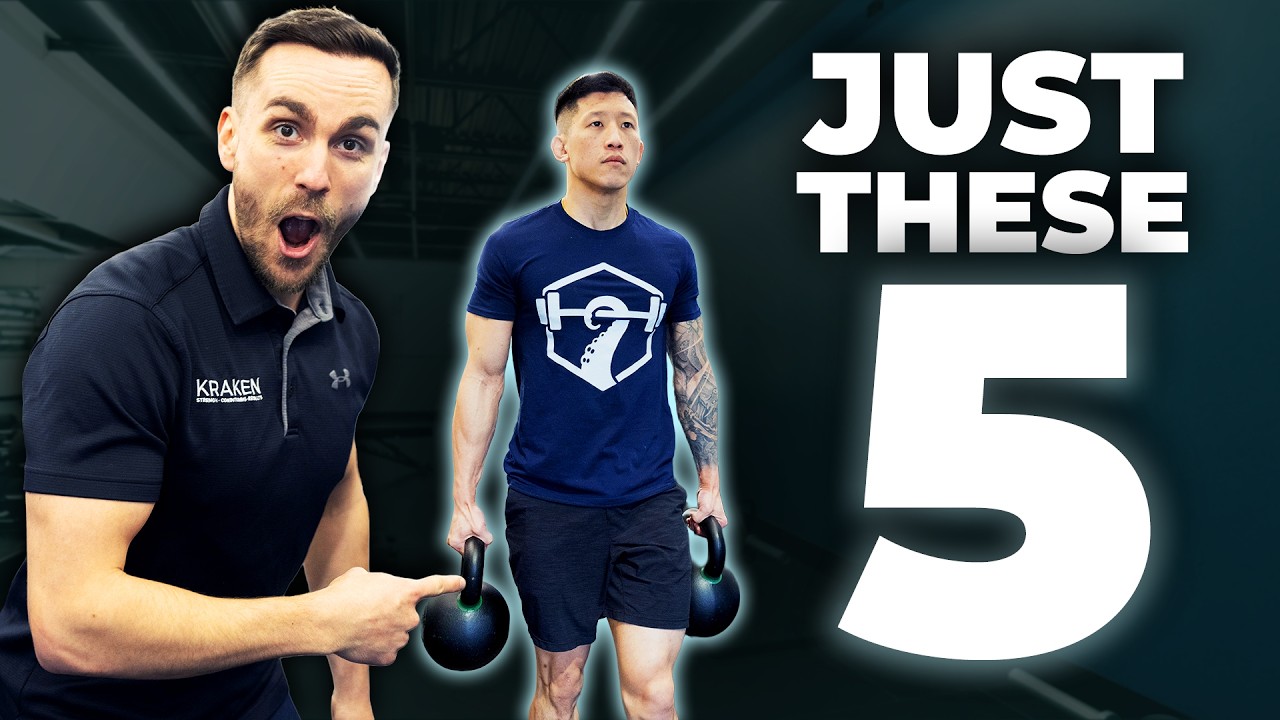
The coaches at Kraken Fitness in North Burnaby have a simple answer: you don’t need hundreds of exercises. You need five. These five movements cover your entire body, build real strength, and give you a foundation you can build on for years.
Exercise 1: Kettlebell Deadlift
The kettlebell deadlift is the first exercise every beginner should learn – and it’s not close. This single movement trains the entire back side of your body at once: lats, upper back, lower back, glutes, and hamstrings. Five major muscle groups from one exercise.
The movement pattern is called a hip hinge. As you lower the weight, your hips push back and your torso tilts forward – the weight stays close to your legs the whole way down. When you stand back up, you squeeze your glutes and drive through your heels. That’s the pattern. Getting comfortable with it takes a session or two, but once it clicks, it clicks.
Why a kettlebell over a barbell to start? The kettlebell sits between your feet, which makes the pattern easier to feel and learn. The barbell comes later, once the mechanics are solid.
Building the posterior chain early – everything from your upper back down to your hamstrings – matters beyond just getting stronger in the gym. It protects your spine. A lot of lower back problems come from posterior chain muscles that are weak and not doing their job. The deadlift addresses all of that in one shot.
If you only did one exercise in the gym, this would be it. Your whole body gets stronger, your back becomes more resilient, and you’ve built the foundation for every pulling movement you’ll ever do.
Exercise 2: Goblet Squat
Once you’ve got the hip hinge, you need the other half of the equation: something that trains the front side of your body, specifically your legs. The goblet squat does that job.
Where the deadlift is about pushing your hips back, the squat is the opposite – you let your knees come forward and drop your hips down toward the ground as low as you can comfortably go. The two movements balance each other out. Deadlift builds the back side (glutes, hamstrings, lower back). Goblet squat builds the front side (quads). Together they cover your entire lower body.
The goblet version specifically – holding a kettlebell or dumbbell at your chest – is the right squat for beginners for a few reasons. The weight in front of you acts as a counterbalance, which helps you sit deeper and keeps your torso more upright than other squat variations. It’s self-correcting in a way that a barbell squat isn’t. If your technique drifts, the weight will tell you.
Quads are a big muscle group and they respond fast to consistent loading. Most beginners notice a difference in their lower body strength within a few weeks of squatting regularly. The goblet squat is the cleanest, simplest way to get there.
Exercise 3: Incline Push-Up
The incline push-up is the right way for most beginners to start training their chest – not a flat push-up, and definitely not push-ups from your knees.
The problem with knee push-ups is that they change the movement pattern too much. You end up training something that doesn’t progress cleanly into a real push-up. You’re stuck in a variation that goes nowhere useful.
The incline version solves this. You control the difficulty by adjusting the height of the surface you’re pushing off – a bench, a box, whatever’s available. Start higher, and as you get stronger, find something lower. A little lower each time, until eventually you’re doing push-ups on the ground with full control.
That’s real progression. The movement pattern stays exactly the same the whole time – only the load changes as the angle decreases. By the time you’re on the floor, you’re not learning a new exercise. You’ve been doing it the whole time, just from a progressively lower angle.
Incline push-ups train your chest, front shoulders, and triceps. For someone just starting out, this is the simplest way to build pushing strength without needing to figure out any machine or barbell setup.
Exercise 4: Chest Supported Row
Every push needs a pull to balance it out. The chest supported row is that pull.
The mechanics are simple: lie face-down on an inclined bench, hold dumbbells hanging below you, and row them toward your hips. The key cue – and the one most beginners get wrong – is pulling toward your hips, not straight up toward your armpits. That hip-direction pull is what gets your lats and mid-back working the way they’re supposed to.
The chest-supported position is what makes this exercise work so well for beginners specifically. When your chest is on the bench, your lower back is taken out of the equation. You don’t have to fight to hold your position while also trying to learn the rowing movement. All your focus goes toward feeling your back work. That’s a big advantage when you’re just starting out.
The muscles you’re training here – lats, rhomboids, rear delts – are the ones responsible for pulling your shoulders back and keeping you from rounding forward. Most people who sit at a desk, drive, or spend time looking at a phone are already tight and weak in these areas. The chest supported row is direct, practical work for exactly that.
Push-ups, then rows. Chest, then back. That balance is what keeps shoulders healthy over the long term.
Exercise 5: Farmer’s Carry
Farmer’s carries are one of the most underrated exercises in the gym – especially for beginners.
The movement is exactly what it sounds like: you pick up two heavy weights and walk. That’s it. But what’s happening while you walk is significant. Your grip and forearms are working hard to hold the weights. Your shoulders are bracing to stop the weights from pulling you down. Your core is engaged the whole time keeping you upright and stable. Your legs are doing steady-state strength work just by walking under load.
It translates to real life in a way that most gym exercises don’t. The strength you build doing farmer’s carries is the same strength you use carrying groceries, moving furniture, or lugging anything heavy any distance. It’s functional in the most literal sense – your body has to work as a unit, not in isolation.
For beginners, it also builds the kind of general strength that makes every other exercise easier over time. Stronger grip means you can hold heavier weights longer in deadlifts and rows. A stronger core means better stability in every movement you do. The farmer’s carry is quietly training multiple things at once in a format that’s completely safe and easy to learn from day one.
Start with a weight you can walk 20-30 meters with good posture – shoulders back, chest up, controlled steps. Add weight or distance as you get stronger.
FAQ
What exercises should a complete beginner start with at the gym in Burnaby?
Start with five foundational movements: kettlebell deadlift, goblet squat, incline push-up, chest supported row, and farmer’s carry. These cover your entire body, balance pushing and pulling, and are all learnable without advanced technique. At Kraken Fitness in North Burnaby, this is the foundation coaches build from with new clients.
Why is the incline push-up better than knee push-ups for beginners?
Knee push-ups change the movement pattern in a way that doesn’t progress cleanly into a full push-up. The incline push-up keeps the same pattern throughout – you just lower the incline over time as you get stronger. By the time you reach the floor, you already know how to do the movement correctly.
What muscles does a kettlebell deadlift work?
The kettlebell deadlift trains the entire posterior chain – lats, upper back, lower back, glutes, and hamstrings – all in one movement. It’s one of the most efficient exercises a beginner can do, building full-body strength while also building resilience against lower back problems.
How do I do a chest supported row correctly?
Lie face-down on an inclined bench with dumbbells hanging below you. Pull the dumbbells toward your hips – not straight up toward your armpits. That hip-direction pull is what engages your lats and mid-back correctly. The chest-supported position takes your lower back out of the equation so you can focus entirely on the rowing movement.
Are farmer’s carries worth doing as a beginner?
Yes – farmer’s carries are one of the best exercises for beginners. They build grip strength, shoulder stability, and core strength at the same time, and the strength carries over directly to real life. Start with a manageable weight, focus on walking with good posture and shoulders back, and add weight or distance as you get stronger.
Ready to Start?
If you’re in North Burnaby and want to learn these movements with a coach who actually shows you how to do them right, Kraken Fitness offers a free trial week. Come in, go through the assessment, and start building strength from day one.