
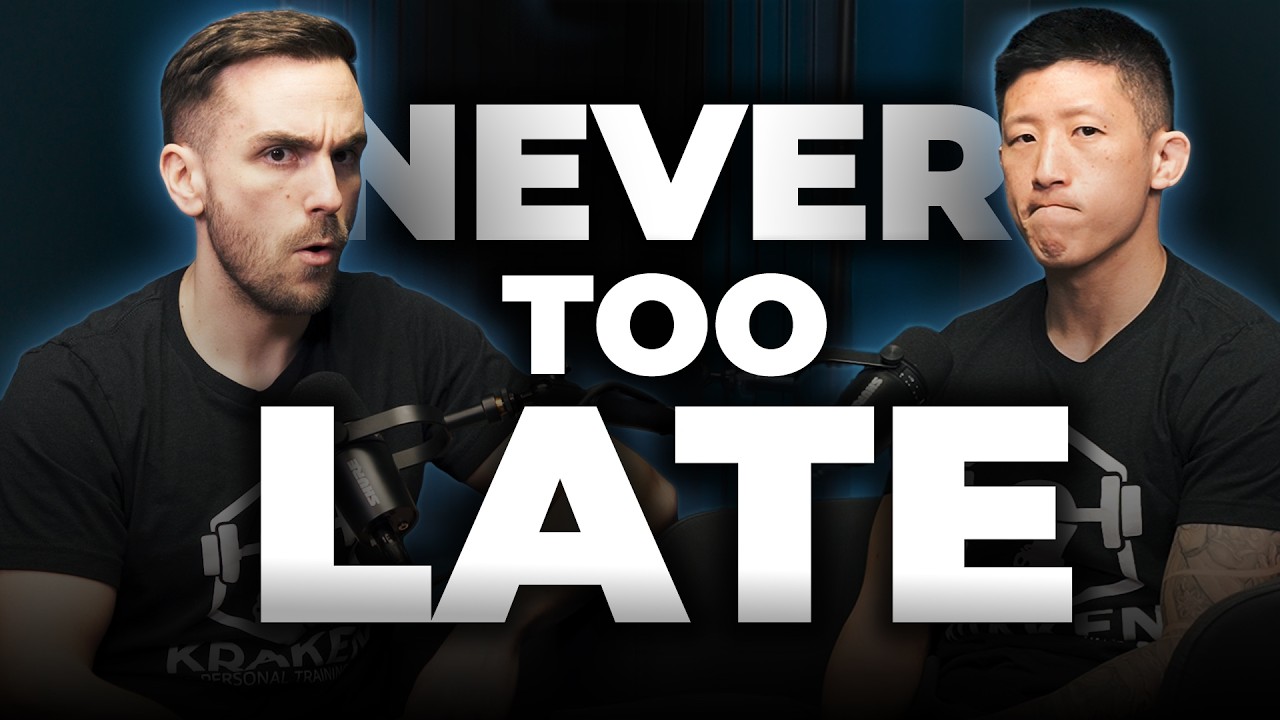
Most people hit their 40s and assume the decline is just inevitable. Their workouts don’t recover the same way. The weight isn’t coming off like it used to. They feel like they’re doing everything right and getting less back for it. In Episode 22 of the Kraken Power Podcast, Josko and Brandon break down the real science behind what changes after 40 – and more importantly, what to actually do about it. Spoiler: it’s not as bleak as it sounds, and it’s never too late to start.
Listen and Watch the Full Episode
Watch on YouTube:
Listen on Spotify:
What Actually Happens to Your Body After 40
The changes are real. Muscle mass typically peaks in your 30s, and after that, you lose 3 to 8% of it every decade without strength training. By the time you hit 50, that can add up to 16% of your peak muscle mass – gone. Bone density starts declining from your mid-20s, and for women, that process accelerates sharply through menopause when estrogen drops rapidly.
On the hormonal side, men lose about 1 to 2% of testosterone every year after 30. That compounds quietly for a decade before most people notice it. Less testosterone means less capacity to build and hold muscle, slower recovery, and changes to energy and body composition that feel like they came out of nowhere.
You also get the visible stuff – wrinkles, gray hair, changes in body fat distribution. These aren’t random. They’re downstream effects of hormonal and mineral shifts that have been building over time.
None of this means you’re broken or that it’s too late. It means the rules change, and if you keep training and eating the same way you did at 25, you’re going to keep getting frustrated. Your body is operating in a different environment now – one that responds really well to the right inputs, and really poorly to the same old volume-first, recover-later approach.
The biggest mistake people make is treating these changes as failures instead of information. Brandon puts it plainly: these are things you have to respect. The earlier you respect them, the better you can work with what your body is actually doing.
The Metabolism Myth Everyone Gets Wrong
A 2021 study found that most people’s metabolism stays relatively stable between ages 20 and 60. That gets shared online as good news – “your metabolism is fine, stop blaming it.” But that framing misses most of the story.
Yes, your metabolism might not be tanking. But what changes dramatically is how much you move. At 20, you might have had a job at McDonald’s, a grocery store, or retail – on your feet all day. Weekends were snowboarding, going out, being active without thinking about it. Then life shifted. Desk job. Kids. Commuting. You went from burning 3,000 calories a day to burning 2,100. That’s a 900 calorie difference that happened gradually and invisibly.
And it’s not as simple as telling someone to “just move more.” That 900 calorie gap was built into the structure of their old life, not something they chose. Now the structure is different, and that genuinely reduces their energy output regardless of what they want to do about it.
For some women, the gap is even more stark. If your metabolism was already on the lower end at 20 and then hormonal shifts knock it down further, you’re now working with a meaningfully smaller calorie budget. That’s not a character flaw. That’s biology, and treating it like willpower failure is both inaccurate and unhelpful.
The takeaway isn’t that metabolism is irrelevant after 40 – it’s that the bigger variable is usually movement, muscle loss, and life load. Fix those, and the metabolism follows.
How to Train Differently After 40
Train less, but train harder. That’s the short version – and it runs directly against how most people think about getting results.
Josko now trains with weights twice a week. At his peak he was doing three, four, sometimes five sessions a week on top of jiu-jitsu. He scaled back, kept the intensity high, added daily walks, and his testosterone actually went up. That’s not an anomaly. When your recovery capacity is reduced, adding more training doesn’t fill the gap – it widens it.
For people over 40, Brandon recommends compound strength movements done at high load with enough rest between sets to actually recover before the next one. Not circuit training. Not running yourself into the ground every session. Heavy work, proper rest, two or three times a week. That structure allows the adaptation to happen without constantly digging a hole your body can’t climb out of.
Machine-based work is completely valid here too. Guided movements reduce the injury risk that naturally increases with age, and the stimulus is the same. A seated leg press, a chest press, a lat pulldown – these are not beginner exercises. They’re appropriate for anyone who wants to train hard and recover properly, at any age.
The compound lifts – squats, presses, hinges, rows – remain important because they build the kind of functional strength that carries into daily life. The difference after 40 is the volume. Less is more. You’re not trying to out-train your younger self. You’re trying to maintain and build from where you are, with enough gas in the tank to actually live your life outside the gym.
Why Recovery Has to Come First
Recovery is where the actual progress happens. That’s true at any age, but after 40 it becomes the whole game.
When Josko was 20, he could lift heavy, snowboard for four hours, sleep five hours, and do it again. Now, that same weekend would wreck the next week of training. That’s not weakness – that’s a changed recovery environment. Fighting it doesn’t work. Working with it does.
The key shift in thinking is this: the gym is not the only load your body is managing. If you have kids, a demanding job, a full schedule, and a night of broken sleep, those are all recovery demands your body is paying for. Adding three hard workouts on top of that doesn’t make you tougher – it just means your body is in debt.
Josko and Brandon talk about this as “life load” – the total stress your body is managing across all sources, not just training. A person who works 10-hour days, sleeps six hours, and manages a family cannot recover from the same training volume as a 22-year-old athlete with no obligations. The program has to account for reality.
If you have a ski trip coming up or a big event at work, that’s the week to do one workout, not three. There’s no shame in that. The intelligent move is to time your training around your life, not force your life to accommodate an aggressive training schedule that your body can’t sustain anyway.
Recovery tools that matter most after 40: sleep quality above everything, daily walking, not training more than two to three times a week with weights, and paying attention to how your body feels on a day-to-day basis. An Oura Ring or any HRV tracker helps make recovery visible, but you don’t need a device to notice when you’re running on empty.
How to Naturally Support Your Hormones
You can’t fully stop the hormonal shifts that come with age, but you can meaningfully slow them and work in the opposite direction. Josko went from a testosterone level of around 650 to 700 ng/dL to over 950 – flagged as high by his doctor – without any pharmaceutical help.
The changes he made: improved sleep quality, reduced training frequency, and adjusted his nutrition to include more foods with saturated fat and cholesterol, both of which are linked to testosterone production. It took a few years, not a few weeks. But the direction was consistently up.
Sleep is the biggest lever. Testosterone is produced largely during sleep – particularly during deep sleep phases. If you’re sleeping five or six hours, you’re cutting your production window short. Prioritizing sleep quality is probably the single highest-leverage thing someone over 40 can do for their hormones, energy, and recovery.
For women, the picture is different. Estrogen doesn’t respond to the same lifestyle variables the same way testosterone does in men, and the drop at menopause is sharper and faster. Strength training is the best tool here – it helps maintain muscle mass and bone density at exactly the point when both are at risk. Protein intake also becomes more critical; the recommended intake for people over 40 is 1.6 to 2.2 grams per kilogram of body weight, higher than what most people are getting.
Hormone replacement therapy is a legitimate option some people pursue with their doctor. That’s a conversation to have with a physician, not a podcast. What Josko and Brandon focus on is the lifestyle side – and the evidence is clear that the lifestyle inputs move the needle more than most people expect.
It’s Never Too Late: Real Results After 60
Two real people from Kraken’s gym make this concrete.
Brandon’s dad is 65. He started training at Kraken about a year and a half ago with no real background in structured strength work. His previous experience was the old-school approach: run yourself into the ground every session, leave drenched, or what’s the point? That model came from an older era of fitness that didn’t account for recovery, load management, or longevity.
He now does two sessions a week – programmed compound lifts, targeted mobility work, high load with proper rest. The result: he plays more pickleball than he did before he started training, and he recovers from it faster. His whole relationship with his body changed.
Grace is 73. She started training in her early 60s. She’s not trying to become a powerlifter. She trains to stay capable, independent, and upright. What she tells Brandon every week is that when she goes out to lunch with her friends, she’s the only one sitting up straight. Everyone else is hunched over. She looks out for the group. That’s the win.
If you’re 40 and you haven’t started yet, you have decades of results ahead of you. If you’re 60 and thinking it’s too late, Brandon’s dad and Grace are both evidence that it isn’t. The body responds at any age – it just needs the right inputs and enough recovery to do something with them.
Kraken Fitness in North Burnaby works with clients across all of these age ranges. The approach scales to where you’re at – not where you think you should be.
FAQ
Does your metabolism really slow down after 40?
A 2021 study found metabolism stays relatively stable between ages 20 and 60. The bigger issue is movement – people move significantly less as life changes (desk jobs, kids, less active weekends). That drop in daily activity, combined with muscle loss, accounts for most age-related weight gain, not a slower metabolism.
How many times a week should I work out after 40?
Two to three strength training sessions per week is the sweet spot for most people over 40. The key is intensity over volume – train hard, then recover fully. Adding daily walking on top of that covers cardiovascular health without eating into recovery capacity that your body increasingly needs.
Can you still build muscle after 40?
Yes. Muscle growth slows compared to your 20s, but it doesn’t stop. The principles are the same – progressive overload, enough protein (1.6-2.2g per kg of body weight), sleep, and recovery. The difference is that recovery takes longer, so training frequency needs to come down while intensity stays high.
What type of training is best for people over 40?
Compound strength movements – squats, presses, rows, hinges – done at high load with adequate rest. These build functional strength that carries into daily life and help maintain muscle mass and bone density. Two to three sessions a week with full recovery between is more effective than five sessions your body can’t adapt to.
Is it too late to start exercising at 60 or 65?
Not at all. The body responds to strength training at any age. Kraken coaches have seen clients start in their 60s and have their lives change – better posture, more capability in sport and daily activity, less injury. The earlier you start the better, but starting late still produces real results.
Ready to Start?
If you’re in North Burnaby and you want a training approach that actually fits where your body is at right now – not a generic program built for a 25-year-old – Kraken Fitness works with clients across all ages and all starting points. A coach will assess where you’re at, build a plan around your recovery capacity and your life, and check in with you every week.
Listen and Watch
Watch this episode on YouTube: https://youtu.be/an6fQwhigEo
Listen on Spotify: https://open.spotify.com/episode/3ncfPra5FlX4867aT8WzWI?si=454df19b0e864d87
Listen on Apple Podcasts: https://podcasts.apple.com/us/podcast/your-body-after-40-why-everything-changes-and-what-to/id1769000945?i=1000770971869